
PRICE TO BEAT
What Is the Price to Beat in a Polymarket BTC 5-Minute Market?
How the BTC reference line defines a five-minute round, why it must be synchronized with the correct window and what fails when traders use an approximate target.
The short answer
The price to beat is the verified reference line used to define the outcome of a specific Polymarket BTC 5-minute round. It belongs to the market’s exact identity, time window, resolution wording and source. It should not be approximated from the nearest exchange quote or carried forward from the previous round.
Evidence boundary: official documentation establishes platform mechanics and source behavior; calculations, examples and interpretations are PolyCerno Research analysis. They do not guarantee an outcome or profit.
Terms used in this guide
- Price to beat
- The verified baseline against which the eligible end observation is compared.
- Compatible observation
- A current value whose source and timing can be meaningfully compared with the market target.
- Market identity
- The condition identifier, time window, outcomes and resolution rule that uniquely define a round.
Price to beat is a baseline, not permission to substitute a spot feed
In the checked September 15 TWAP example, the beginning reference is compared with the rule-specified Chainlink TWAP. A positive Binance price difference cannot establish that comparison. Keep the baseline, deciding observation, source and sampling window separate. A missing TWAP remains missing; neither a latest spot trade nor a hand-built candle average is an authorized substitute.
Price to beat versus current BTC price: a worked example
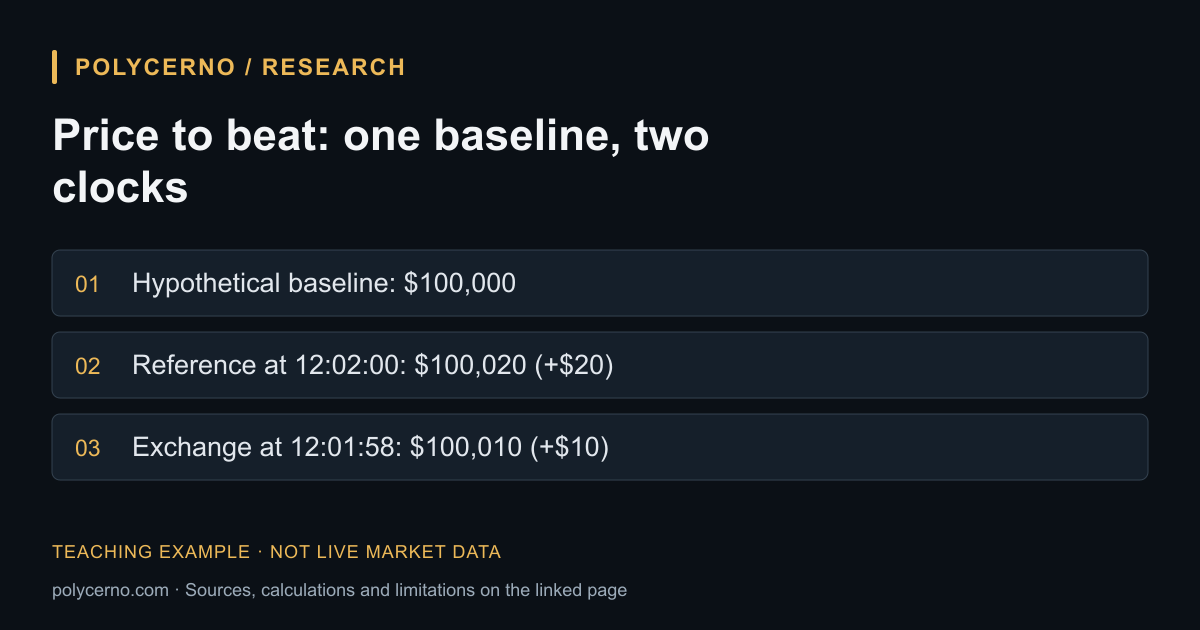
Assume a baseline of $100,000. A reference observation of $100,020 gives a distance of +$20. An exchange observation of $100,010 gives +$10 relative to the same number. These are arithmetic differences, not interchangeable settlement readings: the source and timestamp differ.
In this example the reference is observed at 12:02:00 UTC and the exchange at 12:01:58 UTC. Comparing them does not establish a live $10 discrepancy, a lead-lag relationship or an opportunity. See the two-clock case for the full timeline.
Which value should I use, and what if it is missing?
Use the baseline and reference source specified by the exact market. A nearby exchange chart is contextual unless the rules name it. If the baseline is unavailable, display that absence; do not replace it with zero or the most recent exchange price. Before the eligible ending observation and confirmed result, a positive distance is only a current comparison.
The settlement checklist covers boundaries, equality and result confirmation.
The line that defines the round
A BTC 5-minute Up or Down market compares a defined end observation with a reference specified by the market rules. The reference is often described in the interface as the price to beat.
That number anchors the binary question. BTC movement that occurred before the window opened may be visually dramatic but does not change where the current round settles unless the rules say otherwise.
A target without market identity is unsafe
Consecutive five-minute rounds can have similar titles and very different identifiers, timestamps and targets. A cached target from the previous round can appear plausible while attaching every subsequent calculation to the wrong market.
Store the condition or market identifier with the target, exact time window, resolution wording and source. When a new round activates, invalidate the prior association before rendering the new state.
The nearest exchange quote is not automatically the reference
Binance, another exchange and a designated resolution feed can show slightly different BTC prices at the same moment. Venue, aggregation method, timing and transmission delay all matter.
Use the source named by the market and verify it against the governing rules. Exchange data can provide valuable short-term context without replacing the official settlement reference.
Convert BTC into distance from target
current reference-compatible BTC price − verified price to beatA positive value means BTC is above the line; a negative value means it is below. Also retain basis-point distance and remaining time. A 20-dollar lead has a different meaning when volatility is high or only two seconds remain.
Boundary values require exact rules
Do not assume how equality, rounding, delayed publication or disputed source data are treated. Read the market wording and resolution process. A dashboard may show a simplified UP/DOWN label, but the exact market condition controls settlement.
If the opening reference or final observation is provisional, mark it accordingly and preserve any later official correction in the historical record.
Price-to-beat verification checklist
- Correct market identifier and slug.
- Exact opening and closing timestamps.
- Named resolution source.
- Full-precision target value.
- Current observation from a compatible source.
- Freshness and verification status.
- Explicit handling of equality and exceptional cases.
Sources and further reading
Article updated . Source interfaces and market rules can change; verify the current market before relying on a field. Teaching numbers are constructed examples; source facts and calculations should be read separately.
Put settlement, direction, execution and confirmation on one clock.
Explore the recorded BTC 5-min demo and the evidence behind each directional read.