
SETTLEMENT
How Polymarket BTC 5-Minute Markets Settle
A practical guide to timestamps, price-to-beat references, resolution rules and the settlement checks that come before any BTC 5-minute market analysis.
The short answer
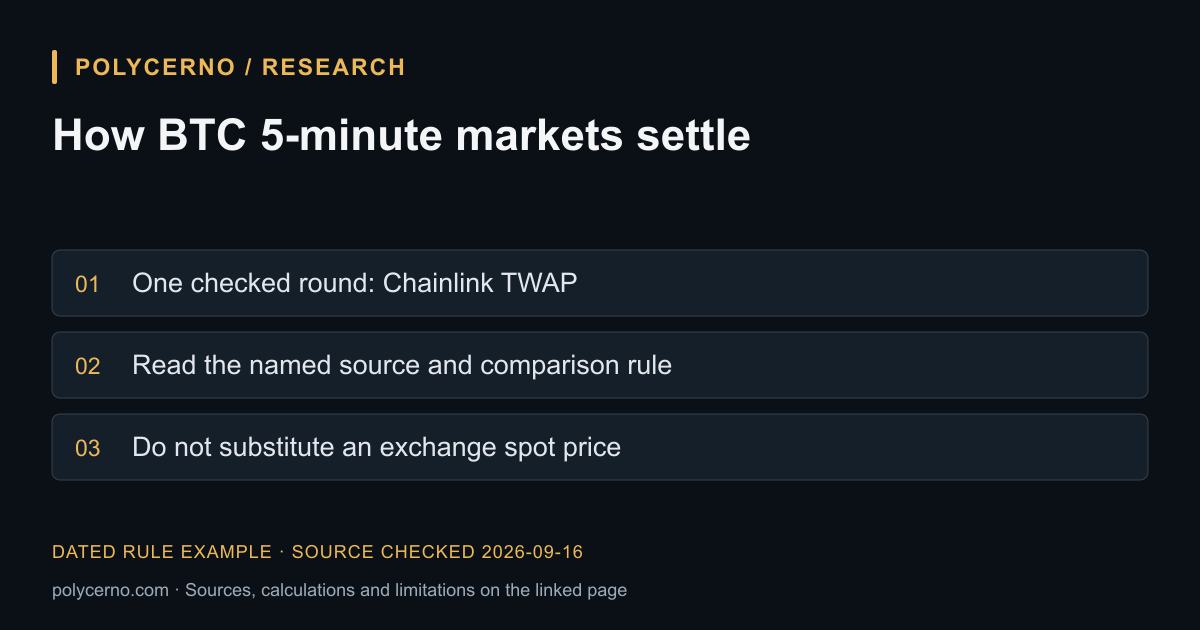
The exact market Rules determine settlement. In the September 15, 2026 example checked here, the named source is Chainlink BTC/USD TWAP and equality with the beginning reference belongs to UP. A Binance last trade cannot substitute for that rule-specified observation. This is a dated rule example, not a universal rule for every historical round or an independently reconstructed settlement result.
Evidence boundary: official documentation establishes platform mechanics and source behavior; calculations, examples and interpretations are PolyCerno Research analysis. They do not guarantee an outcome or profit.
Terms used in this guide
- Resolution rule
- The market-specific wording that determines which outcome wins and how edge cases are handled.
- Settlement reference
- The named source and value used by the market to determine the outcome.
- Price to beat
- The reference line against which the eligible end observation is compared.
A checked market: Chainlink TWAP is not a spot-price close
Checked on 2026-09-16: the Rules section of Bitcoin Up or Down — September 15, 2026, 7:25–7:30 PM ET names a Chainlink time-weighted average price (TWAP), linked to the BTC/USD 60s TWAP stream. Its comparison assigns UP when the specified TWAP is greater than or equal to the beginning reference; otherwise DOWN. Equality therefore belongs to UP in this example.
| Field | What to verify |
|---|---|
| Market | btc-updown-5m-1789514700 |
| Named reference | Chainlink BTC/USD TWAP; not a Binance last trade |
| Comparison | The rule-specified TWAP against the beginning reference |
| Equality | UP for this market, not an assumed universal rule |
| Evidence limit | Rule inspection only; no independent reconstruction of the final feed value or outcome |
A TWAP aggregates prices over time. A spot last trade describes a transaction at a particular time. A five-minute market duration and a feed labeled 60s are not interchangeable averaging instructions: use the exact market wording and feed specification, rather than averaging five minutes of Binance candles yourself. If boundary or sampling details cannot be verified, mark the reconstruction unavailable.
The same market page contains simplified FAQ language about an ending price. The explicit Rules and named resolution source take precedence over that summary. This observation is not evidence of when a platform-wide rule change happened, and must not be applied retroactively to all rounds. Recheck the exact market on each use.
From a five-minute window to a confirmed outcome
- Open the exact market and read its full resolution rules.
- Record the source, opening and ending timestamps, precision and equality rule.
- Compare only observations eligible under those rules.
- Check the officially published resolution; the window ending is not itself confirmation.
The general resolution documentation describes sources, end dates and edge cases. It does not establish one universal feed or equality rule for every BTC market. Preserve the rule text for the particular round.
Does a price just before expiry decide the market?
Teaching example: a hypothetical window is 12:00:00–12:05:00 UTC. A value at 12:04:59.800 is 200 milliseconds before the end; a value received at 12:05:00.200 may have an earlier source timestamp. Neither automatically qualifies as the deciding observation. Follow the market-specific boundary and source rule.
If opening and ending values are equal, consult the equality clause instead of assuming UP or DOWN. A delayed result is also different from a missing price. See price to beat and the timestamp teaching case.
The title identifies the question; the rules decide it
Fast crypto markets often have nearly identical titles. The safe starting point is the full rule text attached to the exact market identifier. It defines the eligible window, source, comparison and treatment of edge cases.
Polymarket’s general resolution documentation makes the same distinction: the title describes the market, while the resolution rules define how it resolves. A five-minute tool should therefore preserve the rule source beside the live observation rather than hiding it in a separate page.
Four fields that must agree
- Start time: when the reference or comparison window begins.
- End time: when the outcome becomes eligible for determination.
- Reference source: the named feed, index or rule source.
- Comparison: whether the ending value must be above, below or otherwise compared with the opening reference.
Timezone conversion is part of the market identity. A correct price attached to the wrong five-minute boundary is not a small timing error; it describes another round.
What “price to beat” means
The price to beat is the baseline that separates the outcomes under the rule. BTC distance is then calculated as the current eligible reference minus that baseline. A positive distance does not by itself guarantee UP, because the window is not finished and the reference may change before the boundary.
current eligible reference − opening referenceThe reference value should carry both its source timestamp and quality state. A cached number without age can look live long after it has stopped being useful.
Why exchange prices and reference values can differ
A Binance trade, an exchange midpoint and a Chainlink feed answer related but different questions. They can update at different times and use different aggregation methods. A source that is useful for market context may not be the source named in the resolution rule.
That is why a decision workspace should label provenance. It can show exchange pressure and cross-market movement as supporting evidence without silently substituting them for the official settlement reference.
How to handle uncertainty
A disciplined system uses visible states such as VERIFIED, PROVISIONAL, STALE, CONFLICT and UNAVAILABLE. It should never turn a missing reference into zero or preserve a last-known value without showing its age.
- Verified: identity, timing and source agree.
- Provisional: useful but awaiting an independent check.
- Stale: the value is older than the decision permits.
- Conflict: independent observations disagree.
- Unavailable: the required fact cannot be supported.
Settlement checklist before reading direction
- Confirm the condition or market identifier.
- Confirm start, end and timezone.
- Read the complete resolution rule.
- Identify the named reference source.
- Verify the opening reference and its precision.
- Check the current source timestamp and quality.
- Keep contextual exchange prices separate from the deciding reference.
Only after these checks should distance, contract prices, flow or wallet activity influence the directional case.
Sources and further reading
Article updated . Source interfaces and market rules can change; verify the current market before relying on a field. Teaching numbers are constructed examples; source facts and calculations should be read separately.
Put settlement, direction, execution and confirmation on one clock.
Explore the recorded BTC 5-min demo and the evidence behind each directional read.