
HYPOTHETICAL DATA · UTC
Two Prices, Two Timestamps: Why Arrival Time Is Not Observation Time
A hypothetical timeline shows why two prices received together can describe different moments, and why that does not prove a market discrepancy.
The short answer
A hypothetical timeline shows why two prices received together can describe different moments, and why that does not prove a market discrepancy. All numerical observations in this case are hypothetical teaching data. The example separates reproducible arithmetic from assumptions about live execution, synchronized feeds or future market outcomes.
Evidence boundary: official documentation establishes platform mechanics and source behavior; calculations, examples and interpretations are PolyCerno Research analysis. They do not guarantee an outcome or profit.
Terms used in this guide
- Source time
- The time attributed to an observation by its source, before it arrives at the receiver.
- Receipt time
- The local time at which an observation arrives, which can differ from the source event time.
- Observation age
- Elapsed time since the source observation, assuming the relevant clocks are synchronized.
A constructed timeline, not a recorded market event
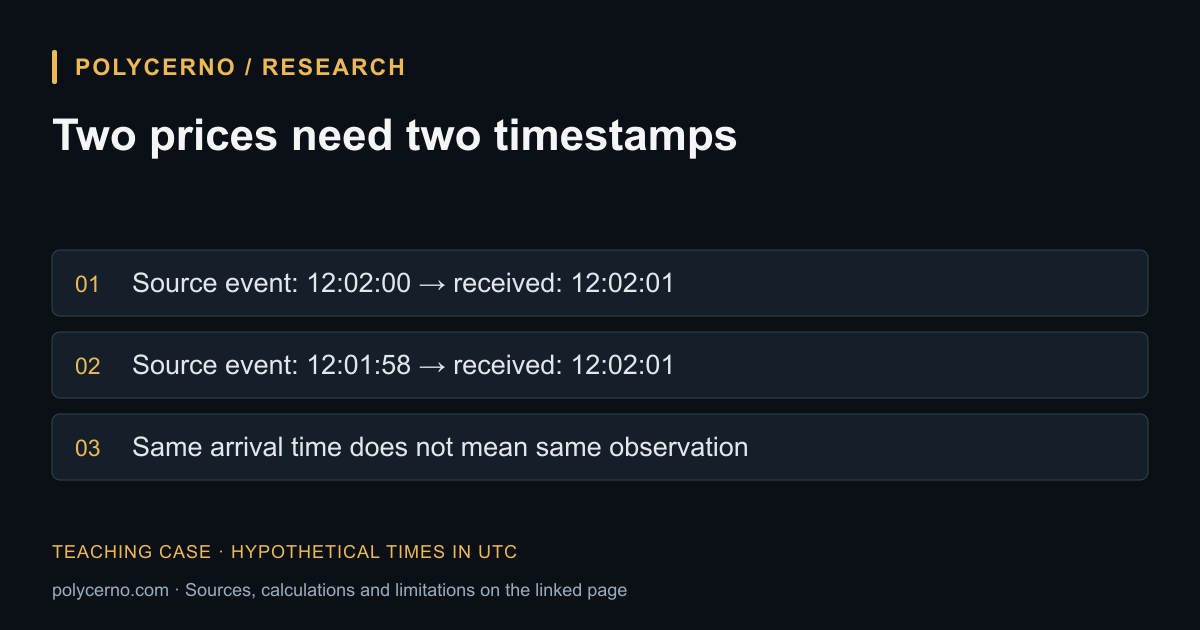
All prices and times below are hypothetical. The example isolates source time, receipt time and source identity; it is not a measurement of Binance or any reference provider’s actual latency. UTC times refer to the same illustrative day.
The observations behind the screen
| Source | Price | Source time (UTC) | Receipt time (UTC) |
|---|---|---|---|
| Reference A | $100,020 | 12:02:00 | 12:02:01 |
| Exchange B | $100,010 | 12:01:58 | 12:02:01 |
The screen receives both at once. Reference A is one second old; exchange B is three seconds old at receipt, assuming synchronized clocks. The observation times differ by two seconds.
What can and cannot be calculated
The arithmetic distances from $100,000 are +$20 and +$10. Subtracting the prices gives $10, but this is a cross-source, cross-time comparison. It does not establish a contemporaneous discrepancy. Without an exchange observation at 12:02:00, the aligned difference is unavailable. Do not interpolate one and label it observed.
Even with aligned clocks, aggregation, trade versus reference definitions and the market’s named settlement source still matter. A source timestamp also depends on synchronized source and receiver clocks.
A repeatable check before comparing
- Identify whether the timestamp means source event, trade or receipt time.
- Normalize units and timezones; retain original provenance.
- Show observation age and missing comparison points.
- Verify which source the specific market rules name.
Binance documents event time and trade time as separate fields. The same distinction explains why a received-at label alone is inadequate. Read price to beat, settlement rules and the timestamp guide.
Sources and further reading
Article updated . Source interfaces and market rules can change; verify the current market before relying on a field. Teaching numbers are constructed examples; source facts and calculations should be read separately.
Put settlement, direction, execution and confirmation on one clock.
Explore the recorded BTC 5-min demo and the evidence behind each directional read.