
HYPOTHETICAL DATA · FEES EXCLUDED
Same Best Ask, Different Depth: A $100 Order-Book Cost Example
Compare two hypothetical order books with a $0.50 best ask. Reproduce the share count, average price and slippage for a $100 budget.
The short answer
Compare two hypothetical order books with a $0.50 best ask. Reproduce the share count, average price and slippage for a $100 budget. All numerical observations in this case are hypothetical teaching data. The example separates reproducible arithmetic from assumptions about live execution, synchronized feeds or future market outcomes.
Evidence boundary: official documentation establishes platform mechanics and source behavior; calculations, examples and interpretations are PolyCerno Research analysis. They do not guarantee an outcome or profit.
Terms used in this guide
- Average price
- Total modeled cost divided by total modeled shares, excluding fees.
- Slippage
- Average price divided by the best supplied ask, minus one, expressed as a percentage.
- Depth shortfall
- The portion of the requested budget unsupported by any supplied ask level in the model.
What this example establishes
This is a constructed teaching example, not a historical Polymarket round, live quote or observed trade. It holds budget and best ask constant while varying depth. The book mechanics are grounded in the linked official documentation; the numbers and calculation are our own.
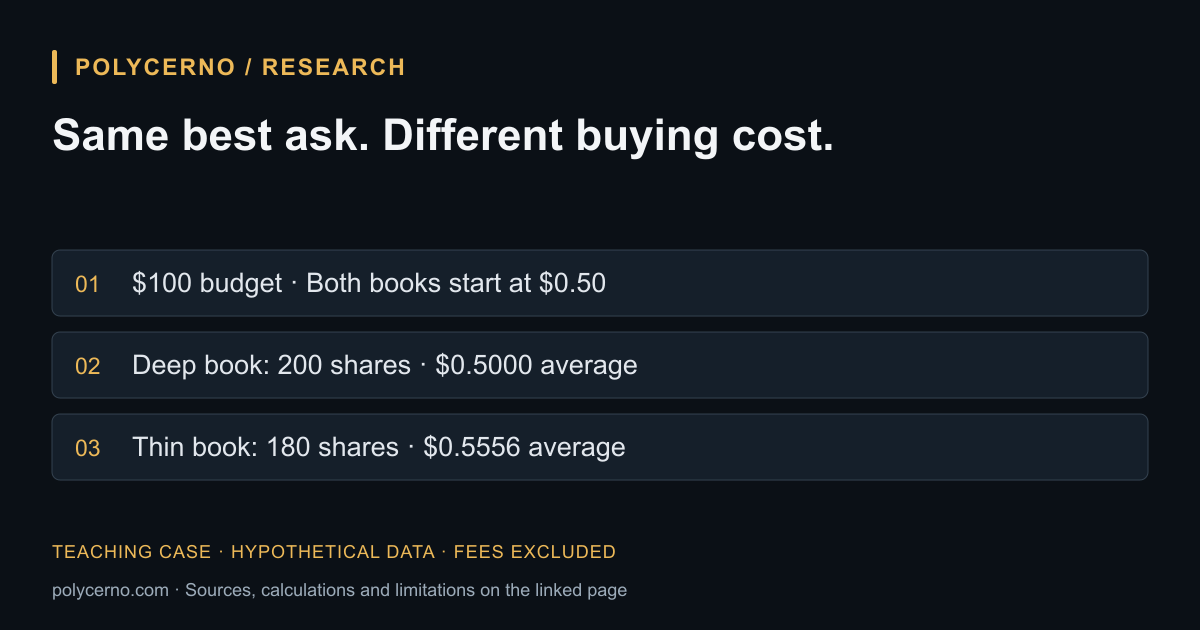
The complete input books
| Book | Ask price | Available shares | Level cost |
|---|---|---|---|
| Deep | $0.50 | 200 | $100 |
| Thin, first level | $0.50 | 100 | $50 |
| Thin, second level | $0.625 | 80 | $50 |
Both budgets are $100. Prices and quantities remain fixed during the calculation. There are no additional levels, fees, minimum sizes or rounding constraints in the model.
Reproduce the calculation
Deep: 100 / 0.50 = 200 shares, with an average of $0.50. Thin: 50 / 0.50 + 50 / 0.625 = 180 shares, with an average of 100 / 180 = $0.555555… . Slippage against $0.50 is 0% and 11.1111…%, respectively. Slippage is a relative percentage here, not percentage points.
Open the calculator: its default thin-book input matches this case. Choose “Deep book” for the comparison, or “Insufficient depth” to use a $120 budget and see $20 left unfilled.
What the example cannot establish
It does not predict a market outcome or prove that any real order would receive these fills. Fees, quote changes, queue behavior, execution constraints and cancellation can change a real result. More shares at a lower average entry price do not establish profitability.
Continue with the depth and slippage guide and timestamp alignment.
Sources and further reading
Article updated . Source interfaces and market rules can change; verify the current market before relying on a field. Teaching numbers are constructed examples; source facts and calculations should be read separately.
Put settlement, direction, execution and confirmation on one clock.
Explore the recorded BTC 5-min demo and the evidence behind each directional read.