
EXECUTION
Polymarket Order Books: Liquidity, Slippage and Real Execution Cost
How Polymarket order books, spreads, depth, VWAP, slippage, fees and partial fills determine the real cost of a BTC 5-minute position.
The short answer
Real execution cost in a Polymarket BTC 5-minute market is the size-weighted price obtained by walking the available order-book levels, plus applicable fees—not simply the best ask shown at the top of the book. Liquidity, spread, partial fills and price impact determine whether a directional advantage remains attractive at the amount a user actually intends to enter.
Evidence boundary: official documentation establishes platform mechanics and source behavior; calculations, examples and interpretations are PolyCerno Research analysis. They do not guarantee an outcome or profit.
Terms used in this guide
- Liquidity
- The amount available to trade at visible prices without excessive price movement.
- Slippage
- The difference between an expected reference price and the average price actually obtainable for the order.
- VWAP
- The volume-weighted average execution price across all book levels consumed by an order.
Move from teaching numbers to a timestamped observation
The worked example below deliberately uses hypothetical numbers. For an observed book, read the dated public-snapshot case, inspect its complete inputs and reproduce the budget calculation. The observation report lists its small sample, failed requests and exclusions. Neither a snapshot nor the report promises execution or a market outcome.
Calculate a $100 purchase across two ask levels
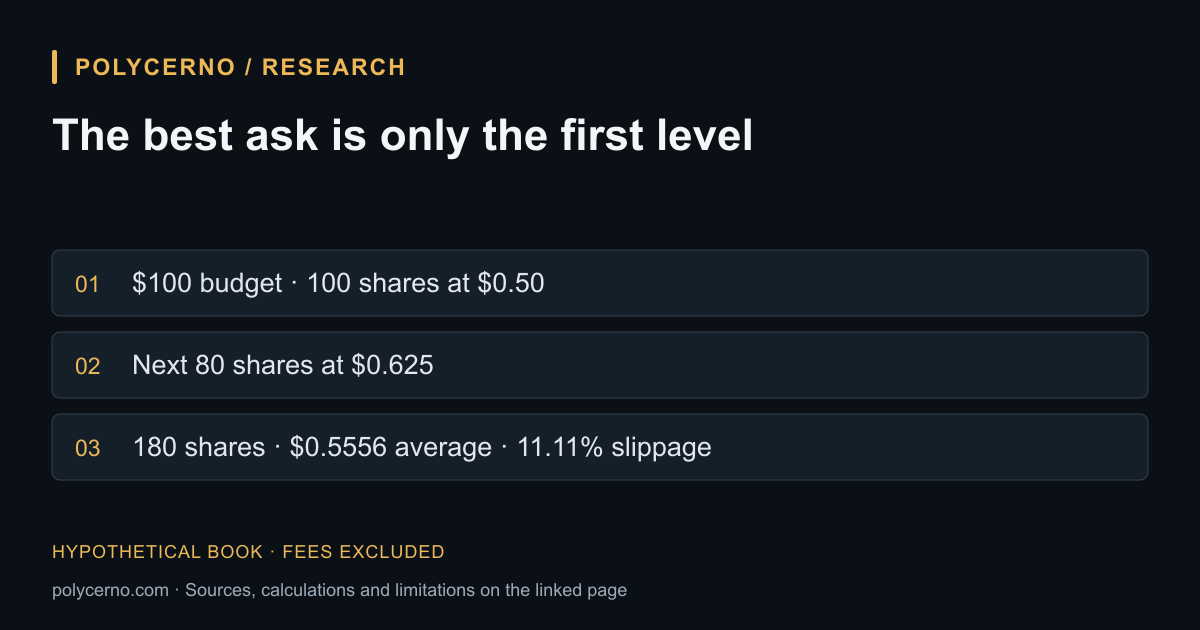
Spend $50 on 100 shares at $0.50, then $50 on 80 shares at $0.625. Total shares = 180. Average price = $100 / 180 = $0.555555… per share. Slippage relative to the initial best ask = ($0.555555… / $0.50 − 1) × 100 = 11.1111…%.
If the budget is $120, the same supplied book still supports only 180 shares and $100 of cost. The remaining $20 is unfilled; no deeper price is assumed. Fees, order constraints and changes after the snapshot are excluded.
Recalculate with the free order-book calculator, or compare the deep and thin book teaching case.
How the Polymarket order book works
Polymarket uses a central limit order book. Bids are resting offers to buy; asks are resting offers to sell. The spread is the gap between the highest bid and lowest ask. Orders that execute immediately consume liquidity from the opposite side of the book.
The displayed market price may be a midpoint or last trade under the platform’s display rules. It is a useful market summary, not a promise that your order will execute there.
Why the best ask is not the final cost
The best ask applies only to the size available at that level. If you want more shares, the order must consume higher asks until the requested amount is filled or visible liquidity runs out.
A 100-share immediate buy cannot be priced at 60¢. It consumes three levels and has an average price above the first ask.
Walk the book to estimate VWAP
For each ask level, take the smaller of remaining desired shares and available shares, multiply by price and continue until filled.
Σ(filled shares at level × level price) ÷ total filled sharesIf the visible levels cannot fill the request, mark the quote incomplete. Inventing liquidity beyond the book creates a more attractive but false estimate.
Keep four execution measures separate
- VWAP: average price of the modeled fill.
- Price impact: difference between the initial reference price and modeled average.
- Fee: current market-specific charge applied under the protocol rules.
- Completeness: percentage of the intended order supported by visible liquidity.
Combining these into one score hides the reason an entry is expensive or uncertain.
Fees vary by market and price
Polymarket’s current documentation describes market-specific fee settings and a price-sensitive taker-fee formula for fee-enabled markets. A tool should query current parameters rather than hard-code a historical rate.
Fee treatment can also affect the number of shares received. That is why expected payout should use actual modeled shares after fee, not simply divide intended notional by the first visible price.
Why five-minute execution is especially fragile
Between reading the book and submitting an order, other participants can cancel or consume liquidity. Queue position, network delay, order matching, market movement and partial fills can all change the result. An execution quote is therefore a time-stamped estimate, not a reservation.
The correct execution question
Do not ask only whether UP or DOWN is more likely. Ask whether the directional case still offers acceptable value after the intended amount consumes spread, depth and fees. If the answer changes sharply between 10U and 100U, size is part of the strategy—not a detail after the decision.
Sources and further reading
Article updated . Source interfaces and market rules can change; verify the current market before relying on a field. Teaching numbers are constructed examples; source facts and calculations should be read separately.
Put settlement, direction, execution and confirmation on one clock.
Explore the recorded BTC 5-min demo and the evidence behind each directional read.